
Home Guides Budget Travel Tactics: Same Trip, Half the Price
Budget Travel Tactics: Same Trip, Half the Price
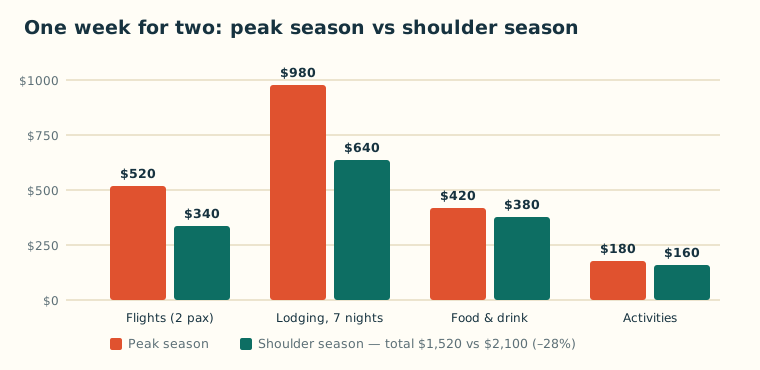
Budget travel has an image problem: people picture misery — overnight buses, dorm rooms, instant noodles. The reality of good budget travel is the opposite. The tactics that cut a trip's cost in half are almost all applied before departure, at the booking stage, and they trade flexibility and planning effort for money rather than comfort for money. Here's where the savings actually are, in order of size.
1. Dates before destinations
The single most expensive decision in travel is locking the destination first and the dates second. Reverse it. Take your fixed holiday window, open a flight search engine's "explore" or "everywhere" view, and let the fares pick the shortlist. The same week, from the same airport, routinely shows 3–5x price differences between equally good destinations. If your heart is set on one place, apply the same flexibility to the dates: departing Tuesday instead of Friday and returning midweek instead of Sunday commonly saves 20–40% on the fare alone.
2. Shoulder season is the whole game
Peak season charges you double for a worse experience: the same beach with more people, the same museum with a queue. Shoulder season — the weeks flanking the peak, when weather is still good and crowds have thinned — cuts flights, accommodation and often local prices simultaneously. For most of Europe that's May–June and September–October; for Southeast Asia, the edges of monsoon season. This one decision is typically worth 30–50% of total trip cost, and nothing else on this list comes close.
3. Fare tracking and the 24-hour rule
Set price alerts on your route 2–4 months out and let the market come to you; fares oscillate, and alerts catch the dips you'd never check for manually. When you book through an airline directly, most jurisdictions give you a 24-hour free-cancellation window — use it to lock a good fare the moment you see it, then verify leave and accommodation before the window closes. Booking direct also matters when things go wrong: third-party resellers save a few dollars and cost you hours when a schedule changes.
4. The alternate-airport check
Secondary airports served by low-cost carriers can halve the fare — but do the full math before celebrating: add the cost and time of the longer ground transfer, and check the arrival time, because a 23:40 landing can convert a $60 fare saving into a $90 taxi. The rule: alternate airports win when the transfer is under 90 minutes and under $25 per person.
5. Lodging math, done honestly
Compare accommodation on cost per usable feature, not per night. A $110 apartment with a kitchen that replaces two restaurant meals a day often beats a $80 hotel room that forces every meal out — especially combined with the market-shopping habit from our meal planning guide; cooking breakfast and one dinner in saves $40–$60 per day for two people in most cities. Location matters more than star rating: a modest room on a transit line beats a nicer one that taxes you $15 a day in getting around.
6. Eat where the price-to-quality ratio lives
The tourist-trap pattern is identical worldwide: restaurants with menus in four languages, photos of the food, and a host outside. The counter-moves are just as consistent: lunch menus instead of dinner at good restaurants (same kitchen, 40% less), markets and bakeries for breakfast, and the one-street-back rule — walk one street away from any major sight before choosing anywhere. Our grocery psychology piece applies abroad too: the same layout tricks operate in every tourist-area shop.
7. City passes: do the arithmetic, not the hope
City sightseeing passes are worthwhile for exactly one traveller: the one who will genuinely visit enough included attractions in the validity window. Price your actual itinerary — the things you'd visit pass or no pass — and buy the pass only if the real list clears the pass price with margin. A pass that changes your plans to justify itself is a cost wearing a discount costume.
8. Pay like a local
Dynamic currency conversion — the terminal offering to charge you in your home currency — is a 3–8% surcharge for the privilege of seeing a familiar number. Always choose the local currency, and travel with a card that doesn't add foreign transaction fees; the secondary digital account in our digital banks guide exists partly for this. Rebate the planned spend where you can, per our cashback stacking system.
Add it up: shoulder season (–35%), flexible dates (–20% on the fare), kitchen lodging (–25% on food), honest pass math (–$50–$100). None of it touches the quality of the trip. It only touches the parts of the price that were paying for someone else's convenience.