
Home Guides Digital Banks vs Traditional Banks: Honest Pros & Cons
Digital Banks vs Traditional Banks: Honest Pros & Cons
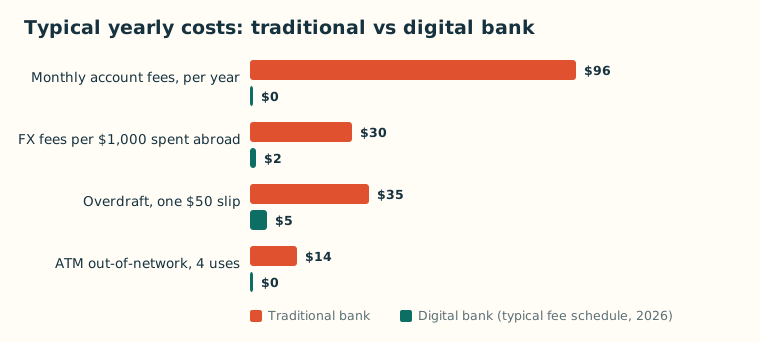
The phrase "digital bank" now covers everything from app-only challenger banks with full banking licences to payment apps that hold your money under a partner bank's umbrella. Meanwhile, traditional banks have spent a decade copying the challengers' apps while keeping their branch networks and their fee schedules. Choosing between them in 2026 is less about ideology and more about knowing which jobs each type is genuinely better at.
We compared both across the six things that actually matter day to day. The short version: for most people the answer is not either/or — it's a specific two-account setup. But the reasons are worth understanding.
Fees: a real, but narrowing, gap
Digital banks built their reputation on free: no monthly maintenance fees, no minimum-balance requirements, free card payments abroad at near-interbank exchange rates. That advantage is real. Traditional banks still commonly charge $5–$15 monthly unless you maintain a qualifying balance or direct deposit, and foreign transaction fees of around 3% remain standard on many legacy cards. The gap has narrowed — most big banks now offer a no-fee tier with conditions — but "free with conditions" and "free" are different products. If your balance ever dips, conditions become charges.
Interest on deposits: check the small print twice
App-based banks often advertise headline rates well above the high-street average. Two caveats apply. First, the best rates frequently live behind conditions — capped balances, required monthly deposits, or introductory periods that expire quietly. Second, some "bank-like" apps are not banks at all: your money sits with a partner institution, and the protection arrangements can be more complex. Before moving savings anywhere, verify that deposits are covered by your country's deposit insurance scheme (FDIC in the US, FSCS in the UK, or the EU's €100,000 guarantee) under an arrangement you actually understand.
The app experience: digital wins, mostly
This is where the gap remains widest. Instant transaction notifications, real spending categorisation, fee-free sub-accounts ("spaces" or "vaults") for ring-fencing bills and savings goals, virtual cards for trials, and in-app card freezing are standard at the challengers and patchy at the incumbents. For anyone running the kind of organised money system we describe in our subscription audit — one dedicated bills account, one spending account — sub-accounts alone are a reason to hold a digital account.
Cash and cheques: traditional wins, clearly
The challengers' weak point is physical money. Depositing cash can mean retail-partner networks with per-deposit fees and low monthly limits, or no option at all. Cheque deposits, banker's drafts, medallion signatures and the other paper machinery of occasional financial life still route through branches. If you run a small cash-heavy side business, or your family still settles things in cheques, a branch network is not nostalgia — it's infrastructure.
Support and problem-solving: it depends what breaks
Digital banks offer fast in-app chat for simple issues, and their apps make self-service genuinely good. But when something unusual goes wrong — a frozen account, a fraud dispute, a probate case — you want a human with case ownership. Traditional banks are slower on easy problems and better on hard ones. The honest summary: digital support is excellent until the day it isn't, and you won't know which day that is in advance.
Resilience: don't put your whole financial life in one app
App outages, account freezes triggered by automated fraud systems, and plain old phone loss all argue against single-bank dependence. An account freeze at your only bank is a crisis; the same freeze at your secondary bank is an inconvenience.
The setup we recommend
For most households, the optimal structure uses both types for what they're good at:
- Primary current account at a traditional or fully licensed digital bank — salary in, mortgage and bills out, deposit protection verified.
- Secondary digital account for daily spending — a fixed weekly transfer in, instant notifications on, virtual cards for trials and subscriptions, fee-free spending abroad when travelling.
The weekly transfer turns your spending into a hard budget without any willpower, and the separation means a compromised card or a frozen account never touches the rent money. If you're assembling the rest of the stack around this, our money-saving app categories guide covers what to add — and just as importantly, what not to.