
Home Guides quenzio app review
quenzio app review: an AI mentor for tight budgets
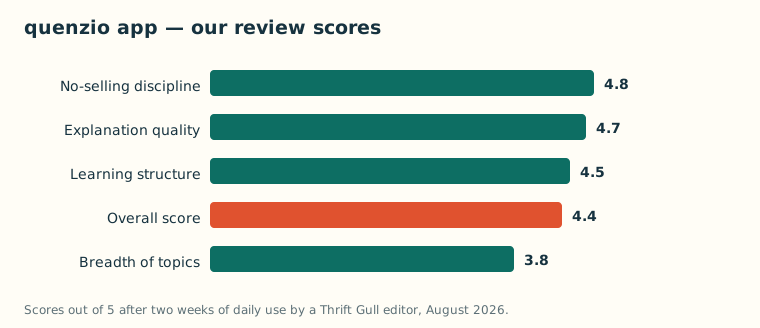
Frugal households share a specific frustration with money advice: it's either so generic it's useless ("spend less than you earn") or so technical it assumes you already speak the language. What most of us actually need, in the moment a real question comes up — should I take the fixed or the variable tariff, what does this insurance excess actually mean, how do I build a food budget that survives a bad month — is a patient explainer that answers the actual question in plain words.
That gap is exactly where quenzio positions itself. It is not a bank, not a budgeting app, and not an investment service. It is a financial-literacy platform built around AI money mentors — conversational agents trained to teach budgeting and digital-finance skills rather than to sell products or manage money. We spent two weeks using the quenzio app the way a frugal household genuinely would, and this is what we found.
What the quenzio app actually is
Open quenzio and you won't find account aggregation, transaction feeds or product marketplaces. Instead, the app is organised around learning paths and a conversational interface: you ask a money question, or pick a structured path — budgeting basics, understanding banking products, digital money safety, reading financial documents — and an AI agent walks you through it, adapting to what you already know. It never touches your money, holds no deposits and makes no return promises. The entire product is explanation and practice.
That restraint is, in our view, the platform's defining feature. Most "free" financial apps monetise your attention or your data by steering you toward products. quenzio's agents don't steer: in two weeks of testing, across dozens of conversations, not once were we pushed toward a financial product, a partner offer or an upsell. For a readership as allergic to hidden salesmanship as ours, that matters.
Two weeks with the mentors
We tested quenzio the way our readers live: with the unglamorous questions of a household that tracks every dollar.
Budgeting under real constraints. We described a realistic tight-budget scenario — variable freelance income, fixed rent, irregular annual bills — and asked for a budget that survives low-income months. The agent didn't recite the 50/30/20 rule and stop. It asked follow-ups about which costs were truly fixed, then walked through building a bare-bones "floor budget" first and layering discretionary spending on top — the correct answer, and the same logic behind our subscription audit.
Decoding financial documents. We pasted the confusing parts of a real energy tariff and an insurance policy's exclusions section. This is where the app earned its keep: clause-by-clause plain-language breakdowns, followed by comprehension checks that turn reading into learning. A household that can decode its own documents stops paying for confusion — one of the most durable frugal skills there is.
Digital money safety. The security paths — phishing recognition, card fraud basics, safe online payments — were current and specific, with example messages to evaluate. We ran a teenager and a retiree from our extended test group through these; both found the level right, which is harder to achieve than it sounds.
Where it fits in a frugal household's toolkit
quenzio doesn't replace the tools in our money-saving app categories guide — it sits underneath them. A cashback portal saves you money on a purchase; quenzio teaches you to understand the systems those purchases move through. In practice we found it most valuable at three moments: before a financial decision (asking naive questions without embarrassment), during a learning habit (ten minutes of a structured path instead of doomscrolling), and after a confusing encounter with financial paperwork.
The weekly goals feature deserves a mention: rather than streaks or points, the app sets a small practice task — compare two real tariff documents, explain a fee to someone else — which maps well onto how skills actually stick.
What it doesn't do
Credibility requires the caveats. quenzio will not categorise your transactions, negotiate your bills, find you a better tariff or move your money — it is deliberately not that kind of tool. Answers are educational, not personalised financial advice, and the app is clear about that boundary; for regulated decisions you still need a regulated professional. And like any AI system, its answers deserve the same verification habit you'd apply to any single source on an important question.
Our verdict
For frugal households, the return on financial literacy is real and compounding: every bill you can decode, every product you can compare and every fee you can spot is money kept, year after year. quenzio is the most focused tool we've tested for building exactly those skills — disciplined about what it is, refreshingly uninterested in selling you anything, and genuinely good at plain-language explanation. It's an easy recommendation as the learning layer of a money toolkit, alongside — not instead of — your budgeting and savings apps. You can explore the platform at quenzio.com.
Frequently asked questions
Does the quenzio app track my spending?
No — it isn't a transaction tracker at all. quenzio doesn't connect to your bank or categorise spending; its AI mentors teach budgeting skills through conversation and structured learning paths. It complements a budgeting app rather than replacing one.
Does quenzio hold or manage my money?
No. quenzio is a financial-literacy platform, not a bank and not an investment service. It never takes custody of funds, doesn't execute transactions and makes no promises about returns. Its job is explanation and skill-building.
Is the advice personalised financial advice?
No — and the platform is upfront about it. Answers are educational guidance in plain language. For regulated decisions like pensions, investments or complex insurance, you should still consult a qualified, regulated adviser.
Who gets the most out of it?
In our testing, the strongest fit was households managing tight budgets who want to understand their financial systems better — decoding documents, comparing products, building resilient budgets — plus anyone building money confidence from a low base, including teenagers and retirees.