
Home Guides Cut Home Energy Bills: 9 Fixes That Pay Back Fast
Cut Home Energy Bills: 9 Fixes That Pay Back Fast
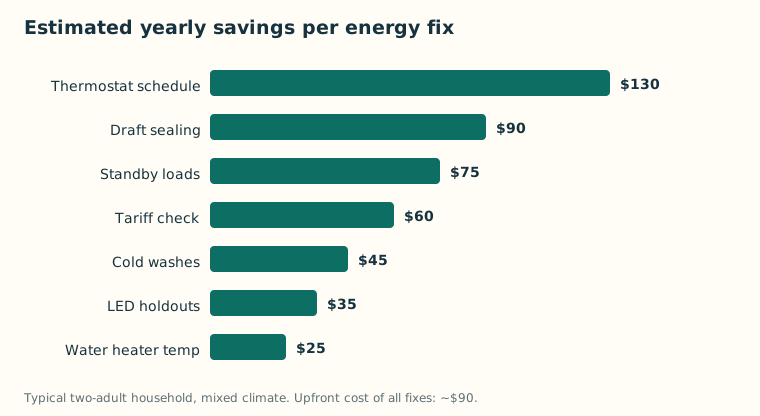
Energy bills resist the usual frugal tactics because you can't see the waste. You can watch a grocery receipt grow at the till; you can't watch a guest-room radiator heating an empty room for six hours a day. The fix is to treat your home like a system with measurable leaks, and to fix the leaks in payback order — cheapest and fastest first.
Below are the nine fixes we recommend, ranked by how quickly they repay their cost in a typical two-adult household. The figures are averages; your tariff and climate will move them, but the order is remarkably stable.
1. Thermostat scheduling — payback: immediate
Every degree you lower the heating setpoint saves roughly 6–8% of heating energy, and heating is typically half the bill. The win isn't suffering through a cold house; it's stopping heating you don't use. Program the schedule around your real routine: setback an hour before you leave, warmup before you return, lower overnight. A $30 programmable thermostat — or the smart scheduling already in your phone-connected one — pays for itself in the first cold month.
2. Standby and vampire loads — payback: 1–3 months
Devices that wait — TVs, consoles, set-top boxes, printers, chargers left in sockets — draw 1–15 watts each around the clock. A typical home leaks $50–$100 a year this way. The fix costs almost nothing: two smart plugs or switched power strips for the entertainment cluster and the office cluster. Kill the cluster when you sleep; the router stays on, everything else goes dark.
3. Cold washes and full loads — payback: immediate
Ninety percent of a washing machine's energy heats the water. Modern detergents are engineered for 30°C, and almost nothing in a normal household wardrobe needs more. Wash cold, run full loads, and skip the tumble dryer when weather and space allow — the dryer is one of the hungriest appliances in the house at $0.30–$0.50 per cycle.
4. LED the last holdouts — payback: under a year
Most homes have converted the main rooms and left the bulbs that matter most: the hallway, porch and kitchen spots that burn the longest hours. A 10W LED replacing a 60W incandescent in a fixture that runs five hours a day saves about $12 a year per bulb — and LED prices have fallen to a few dollars. Do the long-hour rooms first, not the rarely lit cupboard.
5. Draft sealing — payback: one heating season
A $25 kit of weatherstripping, door brushes and sealant routinely cuts 10% off heating and cooling loss. The quick audit: on a windy day, hold a damp hand around door frames, window latches, letterboxes and attic hatches. Cold trails mark the leaks. It is the least glamorous fix on this list and, per dollar, one of the best.
6. Water heater temperature — payback: immediate
Many heaters ship set to 60–65°C; 50–55°C is sufficient for household use and cuts standby losses meaningfully. If your dishwasher has its own heating element — most modern ones do — you lose nothing. Drop the setting, wait a day, and only nudge back up if anyone actually notices. Most households never do.
7. Curtains and zoning — payback: one season
Heavy curtains closed at dusk are measurable insulation, and doors shut on unused rooms shrink the volume you're paying to heat. Combined with the thermostat schedule, "heat the rooms you're in" is the behavioural half of the system — free, and worth 5–10% in older housing stock.
8. Tariff and supplier check — payback: immediate, yearly
Loyalty in energy is a paid position, and you're the one paying. Twenty minutes on a comparison site once a year — with your actual annual consumption from a bill, not an estimate — tells you whether you're on a competitive tariff. In markets with time-of-use pricing, shifting laundry and dishwasher runs to off-peak hours adds another layer on top.
9. The appliance audit — payback: varies
Anything over twelve years old with a compressor or a heating element — fridge, freezer, dryer, immersion heater — is a suspect. An aging fridge-freezer can draw double the electricity of a current efficient model, which puts its real cost at $100+ a year. You don't need to replace working appliances on suspicion; you need to know which ones are expensive to keep. A $20 plug-in energy meter, moved around the house for a month, answers the question with data.
Stacking it up
Individually these are modest. Together, in our reference household, they came to a 22% reduction in annual energy spend — over $400 — with about $90 of upfront cost, all of it recovered within the first heating season. Energy savings also behave like the best kind of budget cut: they recur every month with no ongoing effort, exactly like the wins from a subscription audit. If you want the behavioural version of this list packaged as daily tasks, several of these fixes appear in week three of our 30-day frugal challenge.